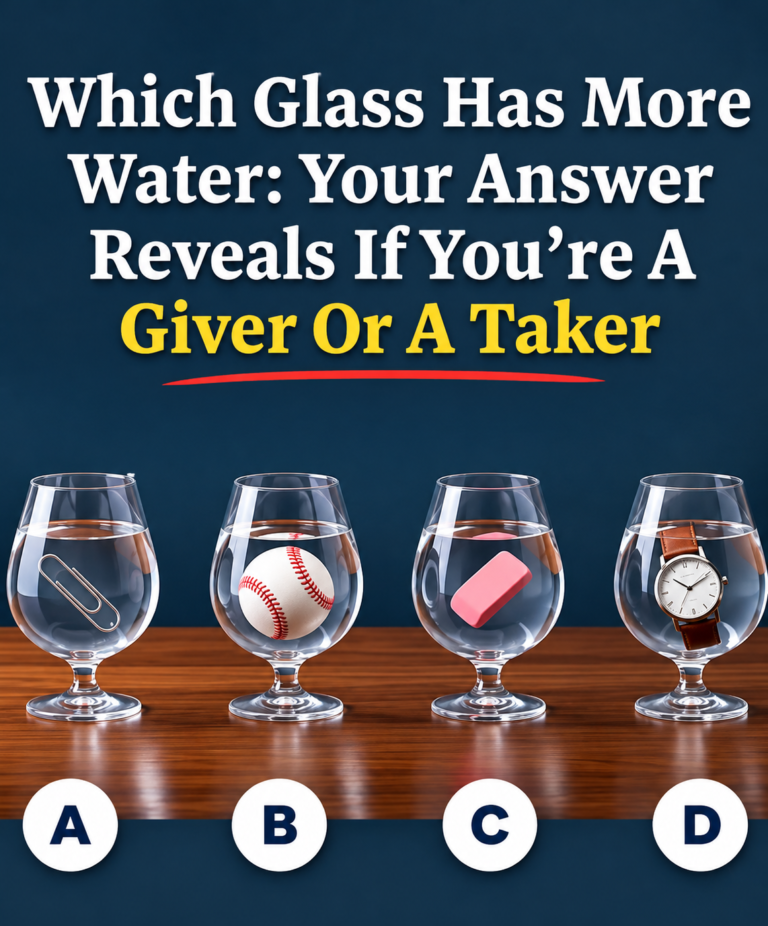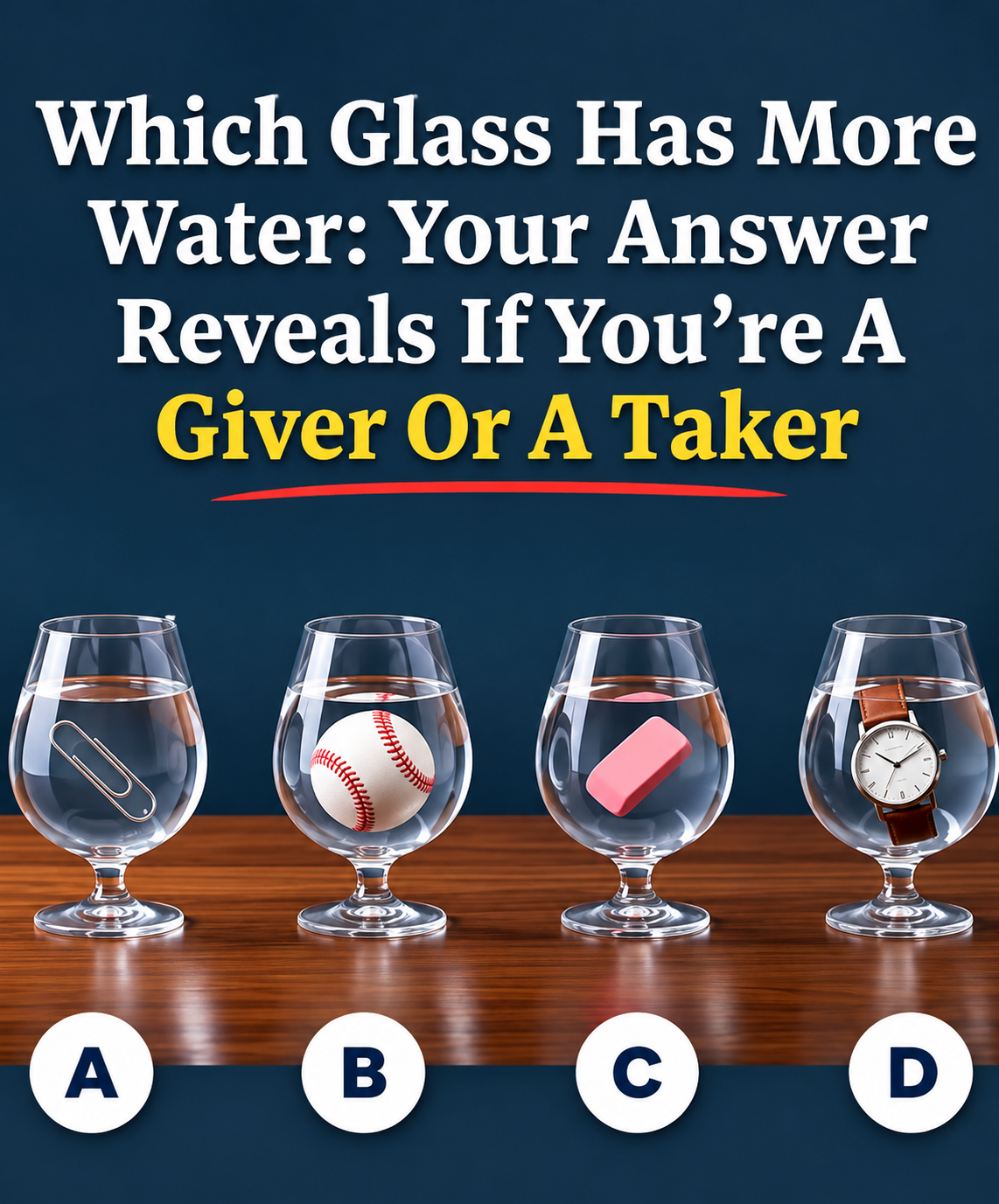
At first glance, this puzzle looks incredibly simple. Four identical glasses appear to contain different amounts of water, but each glass has a different object inside.
One contains a paper clip, another contains baseballs, the third holds an eraser, and the last contains a watch.
But here is the interesting question: Which glass actually contains the most water?
Before choosing, take a moment to look carefully at all four glasses. The answer may not be as obvious as you think!
This brain teaser is based on a simple scientific principle called water displacement. It also comes with a fun personality interpretation that may make you think about the way you approach life and relationships.
Which Glass Has More Water?
The intended answer is Glass A, the one containing the paper clip.
Why?
The answer comes down to the amount of space each object occupies inside its glass.
When an object is placed in water, it takes up space and displaces some of the liquid. Larger objects generally displace more water than smaller objects when fully submerged.
A paper clip takes up very little space compared with baseballs, an eraser, or a watch.
Therefore, assuming the glasses are identical, the objects are fully submerged, and the water levels are arranged as intended in the puzzle, Glass A can contain the greatest amount of actual water.
It is a simple example of why appearances can sometimes be misleading.
The Science Behind the Water Glass Puzzle
This puzzle demonstrates an important concept in physics known as displacement.
When an object enters water, it pushes water out of the space it occupies. This causes the water level to rise.
For example:
- A paper clip displaces a relatively small amount of water.
- Baseballs displace more water because they occupy more space.
- An eraser displaces water according to its volume.
- A watch also occupies space and pushes water aside.
The key is understanding that the visible water level and the actual amount of water are not necessarily the same thing.
Important: The exact answer depends on the dimensions of the glasses, the volume of each object, how deeply the objects are submerged, and the amount of water initially present. Without accurate measurements, a picture alone cannot prove the exact answer.
What Your Choice Might Say About Your Personality
Beyond the science, this puzzle has become a popular conversation starter because people enjoy connecting their answers with personality traits.
The following interpretations are for entertainment only. Choosing a particular glass does not scientifically reveal whether someone is generous, selfish, ambitious, or empathetic.
Glass A: The Analytical Thinker
If you chose Glass A, this personality interpretation associates your choice with careful observation and logical thinking.
You may enjoy looking beyond first impressions and understanding how things really work.
You Notice the Little Details
You might be someone who prefers to examine a situation before making a decision.
Instead of immediately accepting what you see, you consider different possibilities and look for explanations.
This quality can be useful when solving problems, making decisions, and helping people around you.
You Value Understanding
You may believe that understanding a situation is more important than making a quick judgment.
In relationships, this could mean listening carefully before reaching conclusions about someone else’s behavior.
Glass B: The Ambitious Achiever
If you selected Glass B, the entertainment-based interpretation connects your choice with ambition, determination, and big goals.
You may enjoy challenges and feel motivated when working toward something important.
You Like Taking on Challenges
You might prefer difficult goals that push you outside your comfort zone.
You understand that meaningful achievements often require patience, effort, and consistency.
You Think About the Future
You may spend time imagining what you want your life to look like and planning the steps needed to get there.
Glass C: The Practical Problem Solver
Choosing Glass C is sometimes associated with practicality, balance, and common sense.
You may prefer realistic solutions instead of complicated explanations.
You Appreciate Simplicity
You might believe that the best solution is often the one that makes the most sense in everyday life.
You value clear communication and practical decisions.
You Try to Stay Balanced
You may prefer thinking carefully without making every situation more complicated than necessary.
Glass D: The Independent Thinker
If Glass D caught your attention, this interpretation associates your choice with independence, curiosity, and individuality.
You may enjoy forming your own opinions rather than automatically following what everyone else believes.
You Like Making Your Own Decisions
You may prefer exploring different options before deciding what works best for you.
You Appreciate Different Perspectives
You might enjoy conversations with people who have different experiences and opinions because they give you new ways to look at the world.
Are Personality Tests Like This Scientifically Accurate?
It is important to understand the difference between entertainment and psychology.
A simple visual puzzle cannot accurately measure someone’s personality or determine whether they are a giver or a taker.
Real personality research uses more structured methods, carefully designed questions, and scientific evaluation.
That does not mean these puzzles are not enjoyable. They can encourage conversations, challenge assumptions, and give friends and family something interesting to discuss.
The most important thing is not to treat a fun answer as a scientific judgment about yourself.
Why Do Simple Brain Teasers Attract So Much Attention?
Brain teasers are popular because they encourage people to stop, observe, and think.
A puzzle that looks easy can become surprisingly challenging when you notice a detail you initially overlooked.
These activities can also encourage:
- Curiosity and critical thinking.
- Attention to visual details.
- Creative problem-solving.
- Friendly discussions with friends and family.
- Interest in basic scientific concepts.
Sometimes, a simple question is all it takes to start an interesting conversation.
Final Thoughts: Which Glass Would You Choose?
The water glass puzzle reminds us that what we see is not always the complete picture.
While Glass A is the intended answer under the puzzle’s assumptions, the real lesson is about understanding displacement and looking beyond appearances.
And what about the personality interpretations? Take them as a little entertainment rather than a serious assessment.
Now it is your turn!
Which glass did you choose: A, B, C, or D?
Did you get the correct answer on your first try, or did the puzzle trick you?
Share your answer in the comments below. We’d love to know what you picked!