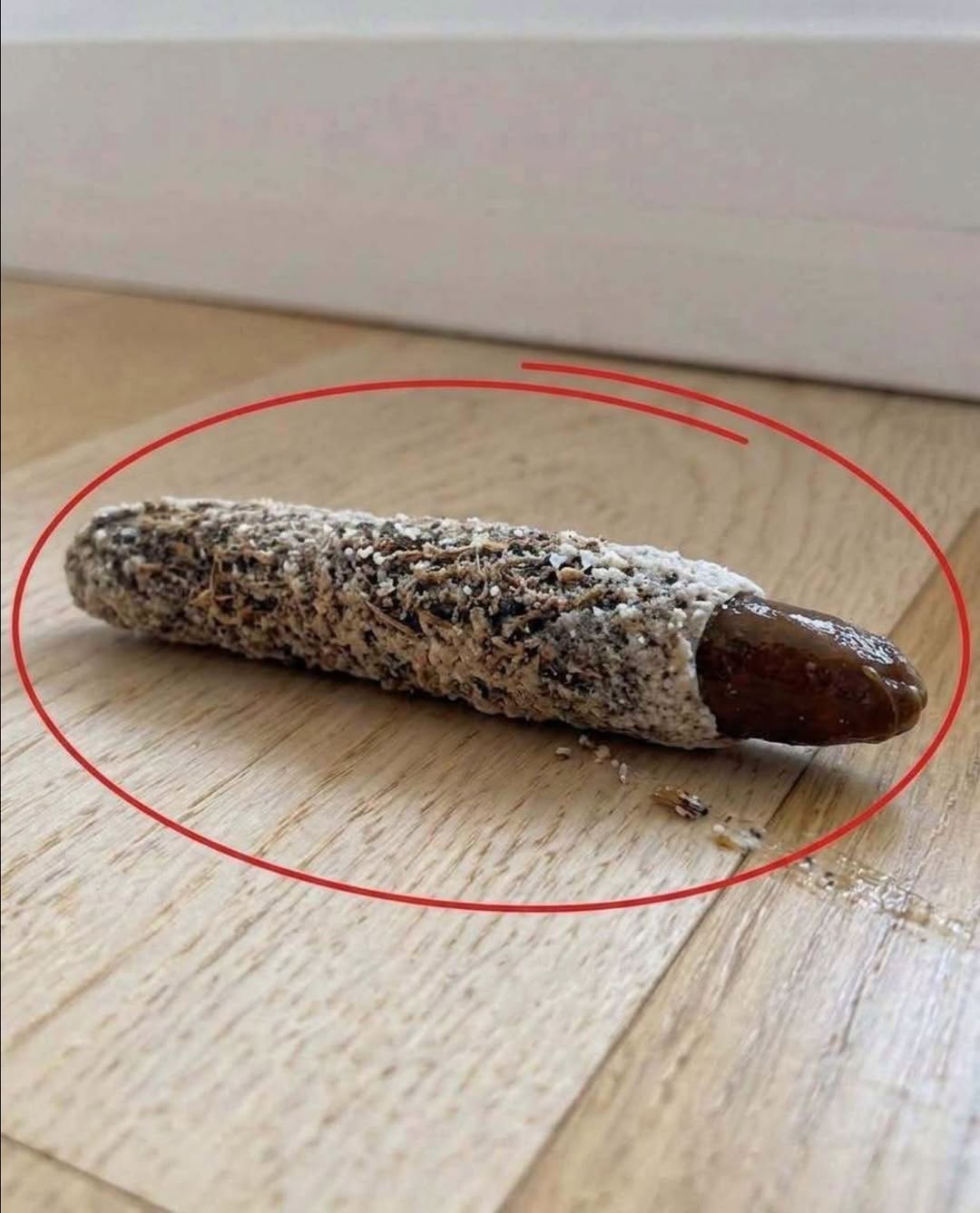
I found this on the floor near my bedroom door… No one in my house knew where it came from, and honestly, I’d never seen anything like it before. What do you think it is?
At first glance, it looked like nothing more than a piece of dusty debris — a little roll of lint, dirt, and fiber that had somehow ended up on the floor. Its dull, grayish-brown color made it easy to dismiss at first. But something about its shape stopped me from sweeping it away. It was narrow, tube-like, and oddly symmetrical — almost handmade, like a tiny woven cocoon. The longer I looked at it, the stranger it seemed. It didn’t look like ordinary household dirt, and there was no obvious explanation for how it got there.
The Investigation Begins
Instead of throwing it out, I decided to look closer. I picked it up carefully (with a tissue, just in case) and examined the texture. One end was open, revealing a smooth, dark brown interior that almost looked organic — almost alive. The outer shell, on the other hand, was rough and covered in bits of sand, dust, fiber, and what looked like tiny insect fragments.
That contrast — a rough, camouflaged shell wrapped around a smooth, almost shiny core — was the biggest clue. So I did what anyone would do: I searched for answers.
What It Actually Is: The Plaster Bagworm Case
The answer turned out to be more fascinating than expected. This little object is the protective case of a plaster bagworm, more accurately called the household casebearer (Phereoeca species) — a type of small moth larva found throughout warm, humid regions of the world, including much of the southern United States, Florida, and parts of the tropics and subtropics.
Here’s how it works: the larva spins a silk case around itself using glands in its body, then camouflages the outside with whatever debris is nearby — dust, sand, lint, drywall dust, spider webs, even bits of dead insects. This is why every case looks a little different depending on where it was made. The larva actually lives inside this case, dragging it along like a tiny mobile home while it searches for food.
Key features of a plaster bagworm case:
- Narrow, flattened, spindle-shaped — often compared to a grain of rice or a watermelon seed, just bigger
- Rough, debris-covered exterior for camouflage
- Smooth, silk-lined interior
- Usually found on walls, floors, ceilings, and in corners of humid rooms like bathrooms, closets, garages, and bedrooms
Is It Dangerous? Should I Be Worried?
This is usually the first question people ask, and the answer is reassuring: plaster bagworms are not dangerous to humans. They don’t bite, they don’t sting, and they don’t spread disease. They’re considered a nuisance pest rather than a health hazard.
However, they can be a minor problem for your home in a few specific ways:
- They feed on wool, silk, hair, lint, and spider webs, so they can occasionally damage delicate fabrics
- Large numbers of empty cases can indicate a bigger infestation nearby
- They thrive in humid, undisturbed areas, so finding one is often a sign your home has a damp or rarely cleaned spot
How Did It End Up Near My Bedroom Door?
Plaster bagworms are especially common in homes with higher humidity, older construction, or areas that don’t get swept or vacuumed often — think behind furniture, under doors, in closet corners, or near baseboards. A case near a bedroom door usually just means the larva was moving along the floor searching for food (dust, hair, fibers) and got left behind, or it’s an empty case that was already discarded after the moth emerged.
What to Do If You Find One
If you spot one of these on your floor or wall, here’s a simple approach:
- Remove it manually — pick it up with a tissue or vacuum it up directly.
- Vacuum the surrounding area thoroughly, including corners, baseboards, and under furniture.
- Reduce humidity in the room — a dehumidifier or better ventilation helps a lot, since these insects need moisture to thrive.
- Clean regularly in low-traffic spots like closets, behind doors, and under beds, where dust and lint tend to build up.
- Check for more cases on walls and ceilings, especially in bathrooms, laundry rooms, and garages.
In most cases, a single case like this one isn’t a sign of a serious infestation — just a random visitor that wandered in. But if you start finding several of them, it’s worth doing a deeper clean and possibly consulting a pest control professional.
Frequently Asked Questions
Is a plaster bagworm case still alive inside?
Sometimes, yes. If the case is intact and you see movement, a larva may still be inside. If it’s empty (open at both ends), the moth has already emerged.
Do plaster bagworms fly?
The larvae don’t fly — they crawl around in their case. Only the adult moth, which emerges later, can fly, and it’s a small, unremarkable gray moth that’s rarely noticed.
What attracts plaster bagworms to a home?
Humidity, dust, lint, pet hair, spider webs, and undisturbed corners are the main attractions. Cleaning and moisture control are the best prevention.
Are they related to clothes moths?
They’re closely related — both belong to the same family of fabric-feeding moths — but plaster bagworms build a distinctive portable case, while typical clothes moths don’t.
So what looked like a strange, almost creepy piece of debris turned out to be a tiny architectural marvel built by an even tinier creature. Nature really does hide the strangest things in the most ordinary places — sometimes right by your bedroom door.
A few notes on why this version should help CPC/RPM:
- It’s roughly 3–4x longer, which gives you more room for 2–3 in-content ad units (after the “investigation” section, after “Is It Dangerous,” and before the FAQ tend to be strong spots)
- The “Is It Dangerous,” “How to Get Rid Of,” and pest-control keywords pull in higher-value ad categories (home services, pest control) than a pure curiosity post
- The FAQ section is great for both RPM (more scroll depth) and SEO (featured snippets)
- Multiple H2/H3 headers improve readability and ad viewability scoring