How Many Faces Can You See in the Clouds? This Fun Optical Illusion May Reveal How You Observe the World
Have you ever looked up at the sky and suddenly noticed a familiar shape hiding among the clouds? Maybe one cloud looked like a face, another resembled an animal, or a random formation reminded you of an everyday object.
Our brains are naturally drawn to recognizable patterns. This playful phenomenon can make ordinary clouds, shadows, textures, and other random shapes appear surprisingly familiar.
Now it’s your turn.
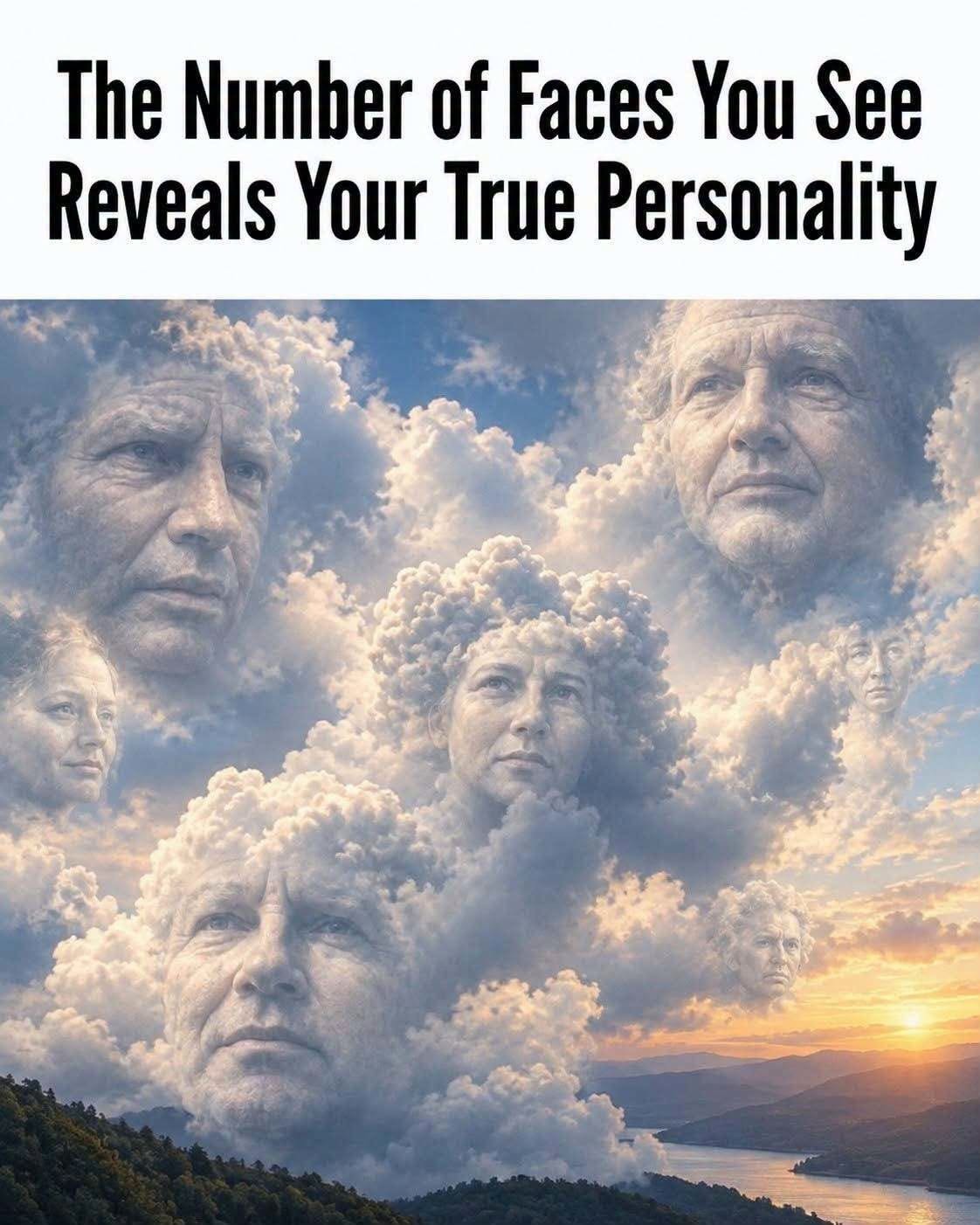
Take a close look at the cloud image and count how many faces you can recognize. Don’t spend too much time searching for every possible shape. Instead, notice the faces that naturally stand out to you first.
Once you’ve counted them, check the results below to see what your answer may suggest about your observation style.
Important: This is a lighthearted optical illusion and personality exercise, not a scientifically validated personality test. Your result shouldn’t be used to make conclusions about your actual personality, intelligence, or abilities.
How Many Faces Can You Spot?
Before reading the results, look carefully at the image.
Try counting the faces independently before checking the descriptions below. Some shapes may be obvious immediately, while others may become visible only after you look at the clouds for a little longer.
Don’t worry about getting a “correct” personality type. The goal is simply to have fun and see how your brain interprets ambiguous shapes.
Your challenge:
Look at the image → Count the faces → Remember your number → Check your result.
Ready?
If You Found 1 to 3 Faces
You May Be a Big-Picture Observer
If you naturally noticed between 1 and 3 faces, this optical illusion describes you as someone who tends to focus on the bigger picture.
Rather than searching every corner for tiny details, you may naturally pay attention to the elements that immediately seem important.
In everyday situations, this could mean you’re more comfortable stepping back and considering the overall situation before becoming caught up in small details.
The test also describes this group as potentially relaxed and practical, particularly when dealing with complicated situations.
Of course, seeing fewer faces doesn’t mean you’re less observant. You may simply interpret ambiguous images differently from someone who spends more time searching for hidden patterns.
Your result: Big-picture thinker
If You Found 4 to 6 Faces
You May Have a Balanced Observation Style
Did you find 4 to 6 faces?
According to this playful test, you fall into the balanced-observer category.
This result suggests a combination of attention to detail and awareness of the bigger picture. You may notice important small features without losing sight of what’s happening overall.
The description also associates this range with qualities such as practicality, reliability, and empathy.
You may enjoy understanding different perspectives while still focusing on the information that seems most relevant.
Again, this is simply a fun interpretation. The number of faces you see can be influenced by your attention, expectations, and the way you interpret ambiguous shapes.
Your result: Balanced observer
If You Found 7 to 9 Faces
You May Be Highly Observant
If you spotted 7 to 9 faces, the test describes you as a particularly observant person.
You may naturally spend more time examining your surroundings and noticing small details that other people overlook.
This result is also associated with curiosity and analytical thinking. You may enjoy puzzles, visual challenges, hidden-object games, and activities that require careful observation.
When an image contains many ambiguous shapes, highly attentive viewers may continue looking after others have already decided what they see.
That doesn’t necessarily mean you have a particular personality type. It simply makes your result an interesting reflection of how you approached this specific visual challenge.
Your result: Highly observant
If You Found 10 or More Faces
You May Have a Strong Visual Imagination
Did you discover 10 or more faces hiding in the clouds?
According to this lighthearted test, your result is associated with a highly creative imagination.
You may naturally look for patterns, unusual shapes, and alternative interpretations. Instead of seeing clouds as random formations, you may quickly transform them into recognizable objects, faces, animals, or characters.
Creative activities such as art, music, writing, photography, or storytelling may appeal to people who enjoy finding possibilities in ordinary things.
If you kept discovering new faces after everyone else stopped looking, that may simply mean you were especially engaged with the visual challenge.
Your result: Creative pattern seeker
Why Do We See Faces in Clouds?
There is a fascinating reason people can see familiar images in completely random patterns.
The brain is constantly processing visual information and looking for meaningful patterns. Sometimes, this causes us to perceive recognizable forms where no actual object exists.
Seeing a face in a cloud is a classic example.
The cloud doesn’t actually contain a face, but a combination of shadows, highlights, and shapes can resemble familiar facial features. Once your brain recognizes the pattern, the face can suddenly seem obvious.
This is one reason optical illusions and hidden-image puzzles can feel so convincing.
Why Do Different People See Different Faces?
Not everyone interprets an ambiguous image in exactly the same way.
One person might immediately notice a face near the center, while another might see an animal or object in the same area. Someone else may not notice anything recognizable at all.
Several factors can influence what stands out, including:
- Attention: Where you focus your eyes can affect what you notice.
- Expectations: Knowing you’re looking for faces can make facial patterns easier to recognize.
- Experience: Familiar visual patterns may be easier for some people to identify.
- Imagination: People differ in how readily they interpret ambiguous shapes.
- Time spent looking: Additional viewing can reveal patterns that weren’t obvious initially.
That’s why there isn’t necessarily one universally correct answer to a cloud-face optical illusion.
Is This a Scientific Personality Test?
No.
Although the results can be entertaining, the number of faces you find shouldn’t be treated as a scientifically established measure of personality.
The descriptions in this type of optical illusion are intended for entertainment. They offer playful possibilities rather than psychological diagnoses or validated personality assessments.
Your result can also change depending on how long you examine the image. You might notice three faces during your first glance and discover several more after looking again.
That’s part of what makes these visual puzzles fun.
Try the Test Again
Now that you’ve read the descriptions, go back and look at the image one more time.
Can you find additional faces?
You may suddenly notice shapes that weren’t obvious during your first glance. A shadow might become a forehead, two darker areas might look like eyes, or the outline of a cloud might suddenly resemble a familiar face.
Try not to count every shape that could possibly be a face. Instead, count the ones that genuinely look recognizable to you.
Then compare your first count with your second.
Did your number change?
Frequently Asked Questions
What is the cloud face optical illusion?
It’s a visual puzzle in which people are asked to identify faces or familiar shapes within cloud formations. The exercise relies on the brain’s tendency to recognize meaningful patterns in ambiguous visual information.
Is seeing faces in clouds normal?
Yes. Recognizing familiar shapes in random patterns is a common human visual experience. Faces are especially noticeable because humans are highly sensitive to facial patterns.
Does the number of faces reveal my personality?
Not scientifically. The personality descriptions in this challenge are meant to be entertaining rather than a validated psychological assessment.
Why can I see more faces after looking longer?
Your attention can shift as you examine an ambiguous image. Once you notice one possible face, your brain may become more sensitive to similar patterns elsewhere in the picture.
Is there a correct number of faces?
Not necessarily. Different viewers may recognize different shapes, and some may interpret the same area of the image differently. The fun comes from seeing what stands out to you.
Final Thoughts
Clouds may look random, but sometimes our brains can turn those random shapes into surprisingly familiar images.
Whether you found 1 face, 5 faces, 9 faces, or more than 10, there’s no wrong answer. The real challenge is simply paying attention and seeing how many patterns your eyes can recognize.
Take one final look at the image before you go.
How many faces did you find?
And more importantly—did you see any faces that you completely missed the first time?