She Faced a $65,000 Puzzle With Almost No Letters Showing—Then Her Answer Left the Entire Studio Speechless!
A Game-Show Moment Nobody Expected
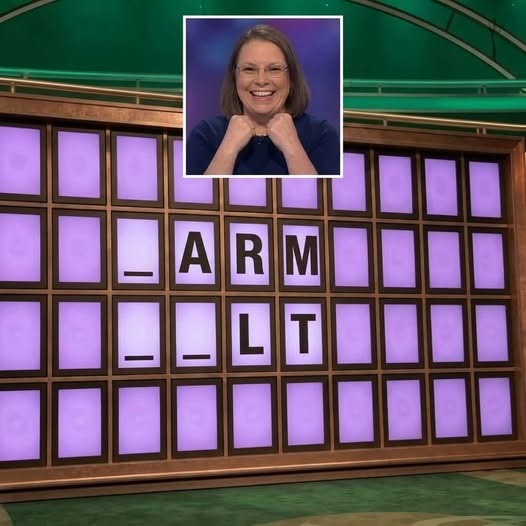
The studio was buzzing with anticipation as one contestant stepped forward to face a puzzle worth an incredible $65,000. On the board, only a handful of letters were visible, leaving most of the phrase hidden. For the audience watching, it looked like the kind of challenge that would require several guesses, careful thinking, and a little luck.
But the woman standing in front of the board seemed to see something nobody else could.
While other contestants might have asked for more letters or taken time to consider different possibilities, she appeared remarkably calm. A small smile crossed her face, as though the answer had suddenly become obvious. The host waited, the audience leaned forward, and the tension in the room grew.
Then she did something unexpected.
Without asking for another letter, she confidently gave her answer.
For one brief moment, the studio seemed to hold its breath. Everyone waited to discover whether her bold decision would lead to a spectacular victory or an embarrassing mistake.
The Answer That Changed Everything
When the answer was revealed to be correct, the atmosphere reportedly transformed in an instant.
Cheers erupted across the studio. Audience members reacted with surprise, and the host turned back toward the contestant, seemingly amazed by how quickly she had solved the puzzle.
What made the moment so fascinating was the limited information available on the board. With so many letters missing, solving the phrase appeared difficult, even for someone familiar with word games.
Yet the contestant seemed to recognize the answer almost immediately.
For viewers, the moment raised an obvious question: How could someone solve a puzzle so quickly when so much of it remained hidden?
The answer may have less to do with magic or extraordinary intelligence than with the way the human brain processes familiar patterns.
Note: The specific game-show episode and contestant are not identified in the supplied account, so the $65,000 prize and the reported reaction have not been independently verified.
How Can Someone Solve a Puzzle With So Few Clues?
One possible explanation is pattern recognition, the ability to identify meaningful arrangements in information that might initially seem incomplete.
When we look at a word puzzle, we do not necessarily process each letter separately. We may also notice the number of spaces, the length of the words, familiar letter combinations, and the kinds of phrases commonly used in that particular game.
These clues can work together to narrow the possibilities.
For example, a familiar expression may become recognizable even when several letters are missing. Once a likely phrase comes to mind, the remaining visible letters can help confirm or reject the guess.
The process can feel instantaneous because the brain does not always present every intermediate step to conscious awareness.
However, the exact explanation for any particular contestant’s success would depend on the actual puzzle, the letters shown, and the answer given.
The Science Behind Instant Recognition
Have you ever remembered the ending of a familiar movie before it happened, recognized a song after hearing only two notes, or completed a sentence before someone finished speaking?
These experiences demonstrate how the brain uses previous knowledge to interpret incomplete information.
Pattern recognition plays an important role in many everyday activities.
- Reading: Experienced readers recognize familiar words without consciously examining every letter.
- Music: Musicians may identify melodies from only a few notes.
- Chess: Experienced players can recognize familiar board arrangements and potential moves.
- Mathematics: People who have practiced a particular type of problem may recognize a useful strategy quickly.
- Word games: Regular players may become familiar with common phrases, letter patterns, and puzzle conventions.
Practice can make recognition faster and more automatic. What looks like a sudden flash of insight may reflect experience and learning accumulated over time.
That does not mean every quick guess is correct. Pattern recognition can also lead people toward the wrong answer when an incomplete pattern resembles something familiar.
Why Confidence Matters Under Pressure
Solving a puzzle in front of a live audience presents a different challenge from working on one at home.
The contestant must make a decision while being watched, knowing that a wrong answer could cost time, money, or an opportunity to win.
In these situations, confidence can influence how quickly someone commits to an answer. But confidence and accuracy are not the same thing.
A confident guess can be wrong, just as a hesitant answer can be correct. The most effective decision depends on the available evidence, the rules of the game, and the potential consequences of guessing.
In a word puzzle, an experienced player may decide that the visible clues strongly support one phrase. If the rules permit an immediate answer, taking that opportunity may be a reasonable strategy.
The excitement comes from seeing someone make that decision in real time, without knowing what the outcome will be.
Could You Have Solved It That Quickly?
Imagine standing in front of a board with only a few letters visible and thousands of dollars potentially at stake.
Would you trust your first instinct, or would you ask for another letter?
Many people would prefer to gather more information before answering. Others might immediately recognize a familiar expression and feel confident enough to respond.
Neither approach is automatically better. The ideal strategy depends on how informative the available clues are and how much risk the contestant is willing to accept.
Try this simple challenge: the next time you encounter a word puzzle, pause before revealing another clue. Look at the word lengths, the letters already shown, and the possible expressions that fit the pattern.
You may discover that the answer becomes clearer when you stop concentrating on individual letters and begin considering the entire phrase.
Why These Moments Become So Memorable
Game shows are designed around uncertainty. Contestants face a problem, make a decision, and wait for the result. When someone reaches the correct answer much faster than expected, that familiar structure produces a powerful surprise.
The audience has time to imagine the difficulty of the challenge, but the contestant’s response arrives before viewers can finish working through the possibilities themselves.
That difference in timing makes the moment especially entertaining.
Viewers may replay such clips because they want to see the clues again, test whether they could have solved the puzzle, or understand what the contestant noticed.
Sometimes, the most impressive part of a successful solve is not the answer itself. It is the gap between how difficult the task appears and how quickly someone manages to complete it.
Final Thoughts
A contestant facing a puzzle with only a few visible letters can remind us how quickly the mind sometimes connects familiar patterns. Experience, attention, previous knowledge, and confidence can all influence how we approach an unfamiliar challenge.
Still, a remarkable game-show moment does not necessarily prove that someone possesses extraordinary intelligence or a special mental ability. Without the original clip and puzzle, we cannot know precisely how the answer was reached.
What makes the story compelling is the possibility that a problem that appears nearly impossible to one person can suddenly become clear to another.
Sometimes, the answer is not hidden because it is complicated. It is hidden because we have not yet recognized the pattern.