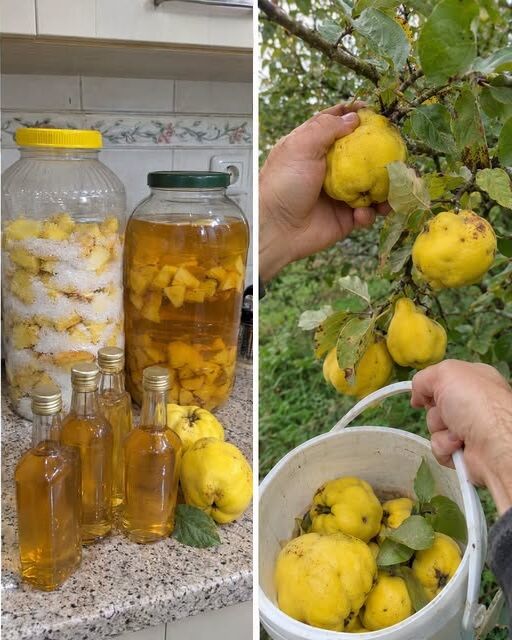
Ripe quinces — 3 large (about 700 g / 1.5 lb). Look for deep yellow skin and a smell you can pick up from a foot away. Green fruit has not developed its aromatics yet and gives a thin, grassy syrup. If all you can find is slightly green, leave it on a windowsill for a week or two.
Granulated white sugar — 500 g (about 2.5 cups). Plain white is the traditional choice for good reason: it dissolves cleanly and stays out of the way. Brown sugar and honey both bully the quince aroma and muddy that gold color. Sugar is not only sweetness here — it is what preserves the cordial, so do not cut it by much.
Fresh lemon — 1. The juice keeps the syrup bright, slows browning, and gives the sweetness an edge to work against.
Autumn spices — optional. One whole cinnamon stick and two or three whole cloves add a warm backbone that suits the season. Use whole spices only; ground spice clouds the syrup permanently and cannot be strained out. A strip of lemon peel or a split vanilla pod both work well too.
You will also want a wide-mouth glass jar of about 1.5 liters, a box grater, cheesecloth or a fine-mesh sieve, and clean bottles with tight caps.
Method 1: The No-Cook Golden Syrup
This is the old pantry method: sugar draws the juice out of the fruit on its own, no stove involved. It keeps the aroma at its freshest and brightest. Active time about 30 minutes; then 48 hours of waiting. Yield: roughly 500 ml.
- Scrub off the fuzz. Hold each quince under warm running water and rub it hard with a rough kitchen towel until the gray down is gone and the skin is smooth. Do not peel it. The peel carries much of the aromatic oil and the color you are after.
- Core the fruit. Halve each quince with a heavy, sharp knife — it will fight you — and cut away the woody core and every dark seed. Discard the seeds; do not crush or chop them (see the questions below).
- Grate, do not chop. Run the halves over the coarse side of a box grater. Grated fruit releases its juice far faster than cubes do. Work quickly, because cut quince browns within minutes, and toss the shreds with the lemon juice as you go.
- Layer it with the sugar. Spoon a layer of grated quince into the jar, then a layer of sugar, and repeat until both are used up, finishing with sugar on top. Tuck in the cinnamon stick and cloves as you go.
- Let the sugar do the work. Seal the jar and leave it at room temperature for 2 hours, then refrigerate for 24 to 48 hours. Stir or shake it two or three times a day. The sugar will dissolve into a thick golden syrup and the fruit will shrink as it gives up its juice.
- Strain and bottle. Pour everything through a fine-mesh strainer lined with cheesecloth. Gather the cloth and squeeze firmly — the last of the liquid is the most concentrated. Funnel into a clean bottle and refrigerate.
Keep the squeezed fruit. There is a whole section below on what to do with it.
Method 2: The Simmered Cordial (Longer Keeping)
Gentle heat gives you more syrup from the same fruit, pulls out more pectin and color, and — bottled hot into sterilized glass — a cordial you can keep in the cupboard rather than the refrigerator. Active time about 1 hour. Yield: roughly 1 liter.
- Prepare the fruit as above. Scrub, core, remove all seeds. Here you can chop into rough 1 cm pieces instead of grating; the simmer will break it down.
- Simmer with water. Put the fruit in a large pot with 1.5 liters of water, the spices, and a strip of lemon peel. Bring to a boil, then lower the heat and simmer uncovered for 35 to 45 minutes, until the pieces are completely soft and the kitchen smells like autumn.
- Steep off the heat. Turn off the burner, cover the pot, and let it sit for 1 hour. Most of the aroma moves into the liquid during this rest.
- Strain without pressing. Pour through a sieve lined with cheesecloth and let it drain on its own for a clear cordial. Pressing the pulp gives you more liquid but a cloudy one — your choice. Set the pulp aside.
- Measure, then sweeten. Measure the strained liquid and return it to the clean pot with 600 g of sugar per liter, plus the juice of the lemon. Stir over medium heat until every grain has dissolved.
- Reduce briefly. Simmer for 8 to 10 minutes, skimming any foam. It will thicken a little as it cools, so stop while it still pours freely.
- Bottle hot. Pour the cordial, still steaming, into bottles you have sterilized in boiling water or a 120°C (250°F) oven. Cap immediately and let them cool upright on a towel.
| Method 1 (no-cook) | Method 2 (simmered) | |
|---|---|---|
| Hands-on time | 30 min + 48 h waiting | About 1 hour |
| Yield from 700 g fruit | ~500 ml | ~1 liter |
| Flavor | Fresher, sharper, more floral | Deeper, rounder, more spiced |
| Keeps | 3–4 weeks, refrigerated | 6–12 months sealed; 1 month once opened |
How to Serve It
The cordial is a concentrate. Start with roughly one part syrup to six parts liquid and adjust from there.
- Hot quince water. A tablespoon in a mug of hot water is the simplest and still the best — the winter equivalent of hot honey and lemon.
- Stirred into tea. A splash in strong black tea, in place of sugar and lemon both. It is excellent in chamomile too.
- Sparkling quince soda. Two tablespoons in a tall glass of cold sparkling water over ice, with a mint sprig. This is the one guests ask about.
- In a mocktail. Quince syrup, fresh lime, and ginger ale, shaken over ice, gives you something that tastes considered rather than apologetic.
- Over dessert and breakfast. Spoon it over vanilla ice cream, pancakes, rice pudding, plain yogurt, or a slice of pound cake.
- In the kitchen. Whisk it into a vinaigrette with cider vinegar, or brush it over roasting pork, chicken, or carrots in the last ten minutes.
Don’t Throw Out the Fruit
Straining leaves you with a generous pile of sweetened, spiced quince pulp. It is intensely flavored, loaded with pectin, and far too good for the bin.
- Turn it into quince paste. This is the famous one — membrillo in Spain, pâte de coing in France. Blend the pulp smooth, cook it down over low heat with a little sugar until a spoon drawn through leaves a clear track, then spread it 2 cm thick in a lined tray and leave it to set for a day or two. Sliced with aged cheese, it is the best thing to come out of the whole project.
- Cook it into jam. Simmer the pulp with a splash of water and a squeeze of lemon until thick and spreadable. Quince needs no added pectin.
- Fold it into baking. Stir it straight into muffin batter, a fruit cake, an apple pie filling, or a crumble.
- Make a glaze. Blend a spoonful with mustard and a little soy sauce and brush it over pork chops or chicken thighs in the last ten minutes of roasting.
The cooked versions keep about a week in the refrigerator, or freeze in small portions.
Storing It
Sugar is the preservative here, so how long a bottle keeps depends on which method you used and how clean your bottles were.
The no-cook syrup is a fresh product. Keep it in the refrigerator in a sealed bottle and use it within 3 to 4 weeks.
The simmered cordial, bottled hot into sterilized glass and sealed, keeps 6 to 12 months in a dark cupboard. Once you open a bottle, refrigerate it and use it within a month.
Keep it dark. Sunlight fades that golden color over a few months. A closed cabinet is enough; dark glass is better still.
Freeze the extra. Either version freezes well in an ice-cube tray. Bag the cubes and drop one into hot water, tea, or a smoothie straight from the freezer — good for a year.
When to throw it out. Any fizzing, any smell of ferment or alcohol, any mold or cloudy haze in a previously clear bottle: discard it. That is a sign of under-sweetening or a bottle that was not clean.
Common Questions
Why remove the seeds so carefully? Quince seeds, like apple and cherry pits, contain cyanogenic compounds that release small amounts of hydrogen cyanide when the seed is crushed or broken. Whole seeds that are removed and discarded pose no problem at all — just do not grate, chop, or blend them, and do not leave them in the pot.
My fruit turned brown while I was working. Is it ruined? Not at all. Cut quince oxidizes within minutes; it is cosmetic. Tossing the shreds with lemon juice as you grate keeps it brighter, and the finished syrup comes out gold either way.
Can I use less sugar? A little, but not much. Sugar is what keeps this safe on the shelf and what pulls the juice out in Method 1. Below about 400 g per liter of liquid, treat the result as a fresh juice: refrigerate it and use it within a week.
Can I water-bath can it? Yes — process filled, sealed jars for 10 minutes at a rolling boil, adjusting for your altitude, and you can store them a year or more. Follow a tested canning guide for your region rather than improvising.
Can I use pears or apples instead? You can, and it is pleasant, but it is a different drink. Neither has quince’s perfume or its pectin. A mix of quince with one pear is a nice middle ground if you are short on fruit.
What about the peels and cores? Keep the peels — they are full of pectin and aroma, and you can simmer them separately with water and sugar for a second, lighter batch. Discard the woody cores with the seeds.
Disclaimer: this article is provided for informational and educational purposes only. Home preserving carries food-safety risks: use clean, sterilized equipment, follow a tested canning guide for your area if you intend to store jars at room temperature, and discard anything that shows signs of fermentation or spoilage. Nothing here is intended as medical or nutritional advice — consult a qualified healthcare professional with any questions about your diet, particularly regarding sugar intake if you are managing diabetes or another health condition. The author and publisher accept no liability for any outcome arising from the use of these recipes.