Quince Cordial: How to Make the Forgotten Golden Syrup of Autumn
Before supermarkets and year-round shipping, putting up the autumn harvest was not a hobby. It was how a household got through winter with something good on the table. In the villages of Eastern Europe and around the Mediterranean, that meant jars — fruit under sugar, syrups and preserves, lined up in a cool pantry and opened when the weather turned.
One of the finest things to come out of that habit is quince cordial: a thick, perfumed golden syrup you dilute by the spoonful all winter long. And it comes from the fruit most people walk straight past.
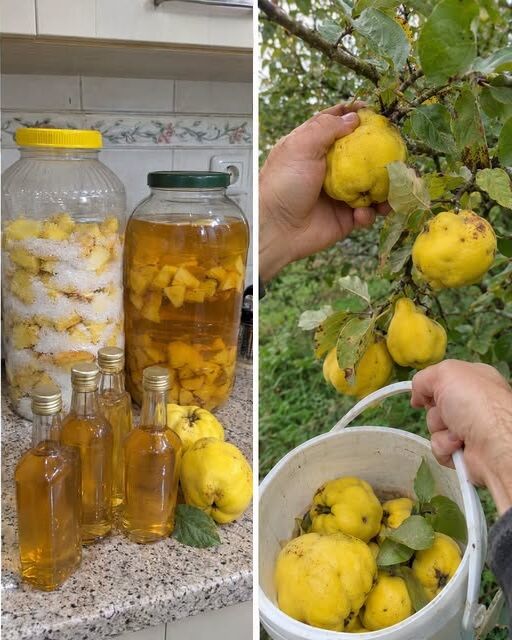
A raw quince is not promising. It looks like an apple and a pear argued about it, it is hard enough to bruise a knife, it is mouth-puckeringly sour, and it arrives covered in a layer of gray fuzz. Nobody eats one out of hand. But give it sugar and a little patience and it turns into something genuinely remarkable — a clear amber syrup that smells like an orchard and tastes like it took far more work than it did.
That is the real appeal of this recipe. Half an hour of work, then time does the rest. Below are two ways to make it — one with no cooking at all, one gently simmered for a longer shelf life — plus how to serve it and how to use every last piece of the fruit.
Why Quince Is Made for This
Soft fruit gives up juice. Quince gives up perfume — and that difference is the whole reason this recipe exists.
The aroma does the heavy lifting. One ripe quince left on a kitchen counter will scent an entire room: apple, pear, a little vanilla, a bright citrus edge over the top. Sugar and warm water pull those aromatics straight out of the fruit, and they end up in the syrup.
The color arrives on its own. Quince flesh is full of tannins and pale pigments that deepen as they oxidize and cook. A finished cordial runs from honey-gold to deep rose-amber with nothing added — no coloring, no caramel. In a plain glass bottle it looks expensive.
It sets up beautifully. Quince is one of the most pectin-rich fruits in the temperate world. That pectin gives the cordial real body, and it is why the leftover pulp turns so easily into paste or jam.
The sourness is a feature. Raw quince is tart and astringent to the point of being inedible. That is exactly what keeps the syrup from cloying: the sugar has something to push against, so you end up balanced rather than sickly.
It is forgiving. No fermentation, no yeast, no temperature to hold. Keep the fruit under the sugar or the water and the recipe looks after itself.
What You Need
Four things, and the quality of each one shows up in the glass.
⚠️ Don’t miss the rest! The full article continues on the next page 👇📖
Tap “Next Page” to see all the details, tips…