Most people yank common mallow out of the flower bed and toss it on the compost pile without a second look. That is a mistake worth correcting, because the low sprawling plant crowding your path is one of the most useful wild greens in the temperate world.
From the Mediterranean to the Middle East to rural Asia, cooks and village healers have been gathering mallow leaves for centuries — stirring them into soups, wrapping them around rice, and spooning the slippery extract down raw throats and sour stomachs. The reason is chemistry, not folklore. Mallow leaves hold an unusual amount of mucilage, a water-loving plant gum, plus natural pectin. Crush them or warm them and they thicken water all on their own.
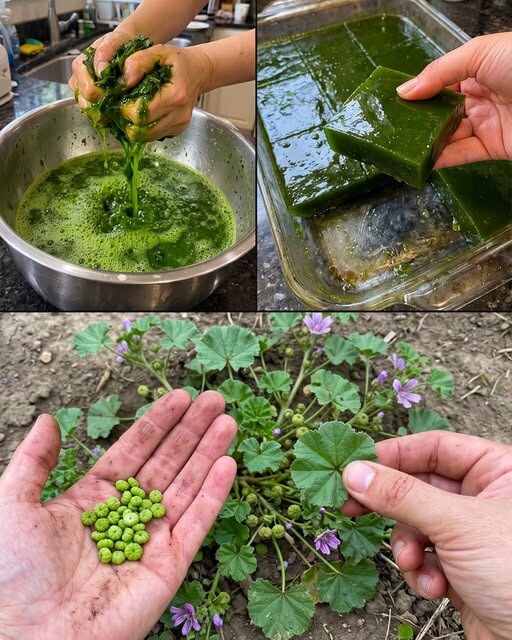
That thickening power is exactly what makes mallow leaf jelly possible. With nothing but fresh leaves, clean water, and a strainer, you can turn a backyard weed into a cool, mild, emerald-green jelly you can eat with a spoon, slice into cubes, or smooth over sunburned skin. This guide walks through identifying the right plants, harvesting them safely, and making both versions of the jelly at home.
The Two Mallows Worth Picking: Malva neglecta and Malva sylvestris
Two close relatives do the job equally well. Use whichever grows near you, or mix them in the same batch — the gel behaves the same.
| Malva neglecta (dwarf mallow, cheeseweed) | Malva sylvestris (high mallow, wood mallow) | |
|---|---|---|
| Habit | Low and sprawling, creeps across lawns, gardens, farmyards | Upright, often 2–4 feet tall |
| Leaves | Round, softly scalloped, dark green — like miniature geranium leaves | Larger, five-lobed |
| Flowers | Small, pale pink to nearly white | Bright purple-pink with dark veins |
| Seed pods | Flat round discs resembling tiny cheese wheels | Same wheel-shaped pods |
| Gel content | Very high, flavor exceptionally mild | High, flavor mild |
The nickname cheeseweed comes from those little wheel-shaped seed pods, and it is one of the quickest confirmations you have the right plant.
Both species sit in the Malvaceae family alongside okra, hibiscus, and marshmallow root (Althaea officinalis). If you have ever watched a pot of okra turn a thin broth into something glossy and thick, you already understand what mallow leaves do in water.
So What Exactly Is Mallow Leaf Jelly?
⚠️ Don’t miss the rest! The full article continues on the next page 👇📖
Tap “Next Page” to see all the details, tips…