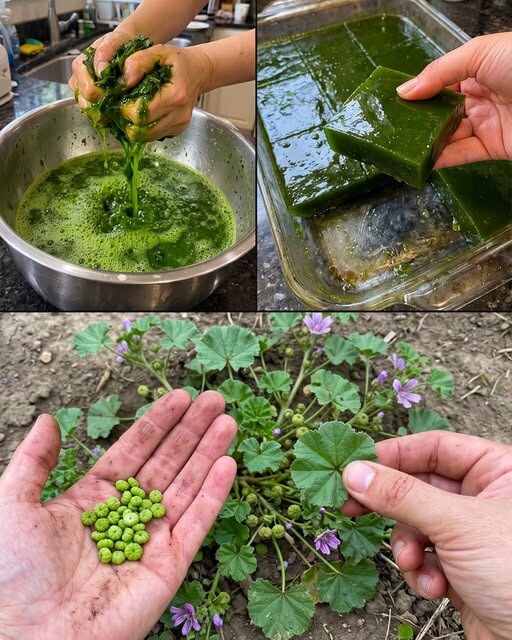
It is the thick juice of fresh mallow leaves, set into something you can eat with a spoon or a fork.
Spinach and lettuce are mostly water held in fiber. Mallow is different: its leaves carry water-soluble polysaccharides — mucilage — along with plant pectin. Blend the leaves with water, press out the coarse fiber, and what runs through the cloth is startling the first time you see it: a glossy, slippery, deep-green liquid closer to aloe gel than to vegetable juice.
From there you have two directions:
- Raw cold-infused gel. No heat at all. The leaves steep in cool water overnight and the mucilage drifts out on its own. This is the soft, spoonable version people reach for when a throat is raw or a stomach is unsettled, and the one you keep in a jar for skin.
- Sliceable set jelly. The leaf extract is combined with agar-agar or pectin, then chilled until firm enough to cut into cubes that hold their edges on a plate. This is the dessert-and-side-dish version.
The flavor surprises most first-timers. Dandelion greens are bitter and nettles bite; mallow does neither. It tastes clean, faintly green, almost sweet — bland enough that children eat it without complaint and neutral enough to go sweet or savory depending on what you add.
Why People Keep Coming Back to Mallow Leaves
Mallow is not merely edible-in-a-pinch survival food. Its traditional reputation rests on one unusual property and a genuinely good nutrient profile.
It coats what it touches. Mucilage makes up roughly a tenth to a seventh of the dry weight of Malva neglecta and Malva sylvestris. These slippery carbohydrates are not digested in the upper gut; they slide along the throat, esophagus, and stomach lining and leave a cool film behind them. That physical barrier is why mallow has been a household remedy for heartburn, reflux discomfort, and general stomach irritation for as long as anyone has records of it.
It calms a dry, tickly cough. A spoonful of cold gel lingers on the membranes at the back of the throat. It is the same principle behind a slippery elm or marshmallow-root lozenge: dampen the tissue, quiet the nerve endings that set off the cough reflex, and give the throat a chance to recover.
It softens things, gently. Soluble fiber of this kind pulls in water and adds bulk without the cramping that comes with stimulant laxative herbs. Hard stool softens and moves instead of being forced along.
It feeds your gut bacteria. Mallow polysaccharides act as prebiotics. What your small intestine does not absorb travels onward and becomes food for the beneficial bacteria in the colon.
It is genuinely nutritious. Weight for weight, wild mallow leaves outperform a lot of what sits in the produce aisle. They supply beta-carotene (vitamin A), vitamin C, and vitamin E, plus meaningful calcium, magnesium, iron, potassium, and zinc.
It is rich in antioxidants. Both species carry flavonoids, phenolic acids, and tannins — anthocyanins too, if you drop a few purple flowers into the batch. These are the compounds associated with calming inflammation and oxidative stress.
It works on skin. Plain unsweetened mallow gel is an excellent after-sun treatment. Spread cold on sunburn, windburn, insect bites, razor burn, or a dry eczema patch, it draws heat out and leaves a thin hydrating film as it dries.
Harvesting Wild Mallow Safely
Good jelly begins before the kitchen. Four rules cover almost everything that can go wrong.
Pick from spring through early autumn. Any green, healthy mallow is usable, but the leaves of spring and early summer are the tenderest and hold the most gel.
Take the young leaves. Work the upper part of the stems where the leaves are bright and soft. Leave the older, lower growth — anything yellowing, dusty, or insect-chewed — on the plant.
Check every underside for rust. Wild mallows are commonly infected with Puccinia malvacearum, mallow rust. Turn each leaf over as you pick. Tiny orange, brown, or rust-colored pustules on the back mean that leaf goes in the compost, not the bowl.
Never harvest from dirty ground. This is the rule that matters most. Mallow is a hyperaccumulator: it pulls heavy metals and excess nitrates out of soil, which makes it a useful remediation plant and a terrible thing to eat from a contaminated site. Skip roadsides, parking strips, industrial lots, dog-walking areas, and sprayed farm edges entirely. Harvest only from clean gardens, untreated lawns, and meadows you know have not been sprayed.
Method 1: Sliceable Mallow Leaf Jelly
Mallow mucilage alone gives you a thick liquid, not a firm block. A small amount of agar-agar turns that extract into clear green cubes that hold their shape on a plate. Makes about 1 liter of set jelly.
What you need
- Fresh mallow leaves (Malva neglecta, Malva sylvestris, or both): 120 g, roughly 4 tightly packed cups, tough stems removed
- Clean drinking water: 1 liter (4 cups), used in two parts
- Baking soda: 1/4 tsp, for washing and holding the green color
- Agar-agar powder: 8 g, about 1 level tablespoon
- Optional: 2 tbsp raw honey or maple syrup and 1 tbsp fresh lemon juice (leave out for a savory or plain batch)
How to make it
- Wash well. Soak the leaves 5 minutes in cold water with the baking soda stirred in, which loosens dust and grit. Rinse twice more under cold running water and pinch off any tough stems.
- Blanch briefly. Bring a pot of plain water to a boil and drop the leaves in for 10 to 15 seconds — just until they flash bright green and soften. Longer than that and the mucilage leaves with the cooking water.
- Shock and blend. Lift the leaves straight into cold water to stop the cooking, drain, and transfer to a blender with 3 cups (750 ml) of the drinking water. Run on high for 60 seconds, until the liquid is thick and velvety.
- Strain. Pour through a fine-mesh sieve or a double layer of cheesecloth. Twist and squeeze the cloth firmly — you will feel the gel pushing through — and discard the dry fiber left behind.
- Dissolve the agar. Whisk the agar powder into the remaining 1 cup (250 ml) of cold water in a small saucepan. Bring to a gentle simmer over medium heat and stir constantly for 2 minutes, until no grains remain. Undissolved agar will not set.
- Combine off the heat. Turn off the burner, let the agar water sit for a minute, then pour in the green extract (and the honey and lemon, if using) while whisking briskly. Adding the leaf juice after the heat is off protects the vitamins and mucilage while the agar still has enough warmth to set.
- Chill and cut. Pour into a glass dish or individual bowls. Leave on the counter about 45 minutes until firm, then refrigerate an hour to chill through. Cut into bite-sized cubes.
Troubleshooting: jelly that will not firm up usually means the agar never fully dissolved, or the mixture was over 1 liter in total volume. Reheat it gently, add 2 g more agar dissolved in a splash of water, and chill again.
Method 2: Raw Cold-Infused Mallow Gel
Heat weakens some of the long, delicate polysaccharides. When the point is maximum soothing power — for reflux, a scratchy throat, or sunburned shoulders — skip the stove entirely. There is almost nothing to this one.
What you need
- Fresh young mallow leaves: 2 cups, washed and torn or chopped small
- Cool or lukewarm filtered water: 2 cups (500 ml)
How to make it
- Bruise the leaves. Pack the chopped leaves into a clean glass jar and press and mash them against the bottom with the back of a wooden spoon for about a minute. Breaking the cell walls is what releases the gel.
- Steep cold, overnight. Pour the water over the leaves, seal the jar, shake it hard, and refrigerate for 8 to 12 hours. Give it another shake whenever you happen to open the fridge.
- Strain and squeeze. By morning the water will have turned thick and viscous. Pour it through cheesecloth and squeeze hard to get every last bit of gel. Store in a clean sealed jar in the refrigerator.
Use lukewarm rather than ice-cold water if you want a thicker extract — the mucilage disperses a little more readily, without the heat that degrades it.
Ways to Use Your Mallow Jelly
For stomach and throat comfort
- A morning coating. Two to three tablespoons of plain unsweetened jelly or raw gel first thing on an empty stomach, or about 20 minutes before a meal, to put a layer between the stomach lining and whatever is coming.
- Throat spoonfuls. One tablespoon of cold jelly with a drop of raw honey, let to melt slowly at the back of the throat whenever a dry cough or a hoarse voice sets in.
At the table
- A cold dessert. Spoon the cubes into a bowl and pour chilled coconut milk over them. Berries, a thread of honey, or a splash of mint or elderflower syrup all work.
- In cold drinks. Dice the firm jelly small and drop it into iced herbal tea, lemonade, or a fruit infusion — a hydrating, fiber-rich version of boba.
- A savory side. Because plain mallow jelly tastes of almost nothing, it takes dressing well: olive oil, a splash of apple cider vinegar, sea salt, and finely diced cucumber make a cooling summer salad.
On skin
- A cooling pack. Keep a jar of plain gel in the fridge and spread it thickly on sunburn, windburned cheeks, bug bites, or itchy dry patches. Leave 15 minutes, then rinse with cool water.
- An under-eye compress. Soak two cotton pads in cold gel and rest them on closed eyes for 10 minutes for morning puffiness and dry lids.
Storing It
There are no preservatives in any of this, so treat it like fresh food.
| Sliceable agar jelly | Raw cold-infused gel | |
|---|---|---|
| Refrigerated | 3 to 4 days in a sealed glass container | 3 to 4 days in a sealed glass jar |
| Frozen | Not recommended — the water separates and the thawed jelly turns spongy | Freeze in ice-cube trays, up to 3 months |
Those frozen gel cubes are worth making deliberately. Rub one straight onto a bug bite, or drop a couple into a smoothie.
Safety Rules You Should Not Skip
Malva neglecta and Malva sylvestris are among the safest wild edibles there are. That still leaves a handful of rules worth following.
Keep it away from your medication schedule. This is the single most important one, and it applies to every high-mucilage plant. A gel layer across the stomach and intestinal wall can slow or reduce how much of an oral drug gets absorbed. Leave at least one to two hours between mallow jelly and any prescription medication or supplement.
Watch your blood sugar if you manage it. Viscous soluble fiber slows the rate at which carbohydrate reaches the bloodstream. That is usually welcome, but if you take insulin or oral glucose medication, add concentrated mallow dishes gradually and check your levels while you do.
Start small. A digestive system unaccustomed to soluble fiber can respond to a large bowl with fullness, gas, or bloating. Begin with 2 to 4 tablespoons and drink plenty of water through the day.
Be certain of the plant. Confirm all of it before you pick: round or five-lobed scalloped leaves, five notched petals, and the unmistakable flat, wheel-shaped seed pods. If any one of those is missing, leave the plant alone.
Allergies and pregnancy. Anyone with a known allergy within the Malvaceae family — hibiscus, okra — should avoid mallow. Cooked mallow leaves are eaten as an everyday vegetable across many cultures, but concentrated medicinal gels are a different matter: if you are pregnant or breastfeeding, ask your doctor or midwife first.
Common Questions
Can I use dried mallow leaves? You can make a usable mucilage infusion from dried leaves, but it will be thinner and duller in color. The sliceable version really wants fresh leaves.
Can I substitute gelatin for agar? Yes, though agar sets firmer, holds up at room temperature, and keeps the jelly plant-based. If you use gelatin, bloom it in cold water first and never boil it.
Can I use the flowers too? Yes. A handful of purple Malva sylvestris flowers adds anthocyanins and tints the batch toward violet, which is a nice touch in a dessert version.
Why did my jelly turn brown-green instead of bright green? Over-blanching, usually. Ten to fifteen seconds is genuinely all it takes, and the pinch of baking soda in the wash water helps hold the color.
Can children eat it? Mallow is a traditional children’s food in many cultures and the flavor is mild enough that most will accept it. Keep portions small, and check with a pediatrician before giving concentrated gels to a child under one year or to any child on medication.
Disclaimer: this article is for educational and informational purposes only and is not medical advice, diagnosis, or treatment. Speak with a qualified physician, pharmacist, or other healthcare professional before trying unfamiliar wild foods or homemade herbal preparations — particularly if you are pregnant, nursing, managing a medical condition, or taking prescription medication. When foraging, botanical identification and the cleanliness of your harvest site are entirely your own responsibility. The author and publisher accept no liability for any adverse effect, allergic reaction, drug interaction, or health consequence arising from the use of the information or recipes here.