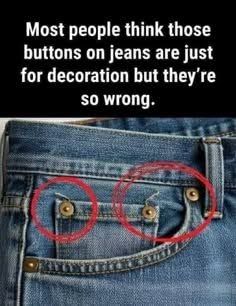
Unlike ordinary decorative buttons, rivets are attached through the denim to help strengthen the fabric and keep the pocket seams from pulling apart.
Why Did Jeans Need Them?
The story goes back to the 19th century, when jeans were primarily made as durable work clothing.
Workers such as miners needed trousers that could survive long hours of demanding physical work. Pocket seams were particularly vulnerable because people regularly carried tools and other heavy objects in them.
Tailor Jacob Davis came up with the idea of reinforcing these weak points with metal rivets. He later partnered with Levi Strauss, and the two patented the riveted work-pants design in 1873.
The idea was simple: instead of relying only on stitching, add a strong metal fastener at the points where the fabric was under the most strain.
They Weren’t Originally About Fashion
Today, those copper-colored rivets are strongly associated with the classic look of jeans.
But their original purpose was much more practical.
The rivets helped make work trousers stronger and more durable. The design became so closely associated with jeans that the little metal details eventually became part of the visual identity of denim itself.
So when you see those little buttons on a pair of jeans today, you’re actually looking at a feature that started as a solution to a very practical problem.
Why Are They Still There Today?
Modern jeans don’t necessarily experience the same kind of extreme working conditions as the original work trousers.
Yet rivets remain a familiar feature of many jeans because they’ve become part of traditional denim construction and styling.
For example, Levi’s still describes the rivets on its 501 jeans as being designed to add strength to the pockets.
Over time, some manufacturers also changed how rivets were used. In certain vintage jeans, the metal rivets were eventually covered or concealed because customers complained that exposed rivets could scratch furniture and saddles.
A Tiny Detail With A Big History
It’s funny how many everyday objects contain little details that have a story behind them.
Those tiny metal pieces on your jeans may look like decoration today, but they started as a clever way to make trousers stronger and more suitable for hard work.
So next time you put on your favorite pair of jeans, take a closer look at the pockets.
Those little metal buttons aren’t just there to make your jeans look good. They’re a small reminder of how everyday clothing was designed to solve real problems.
Did You Know This?
Most people probably never knew the real reason behind those tiny metal rivets.
Did you think they were just decoration?