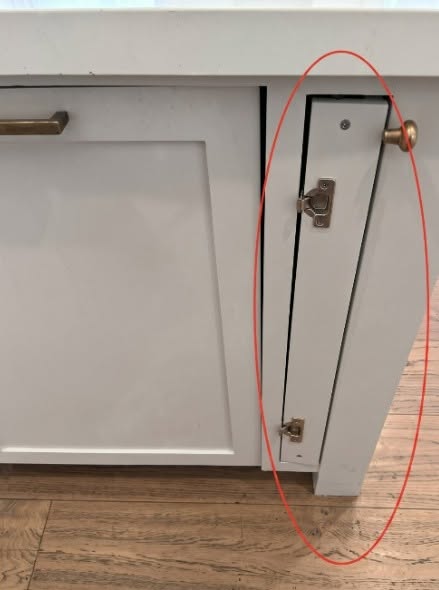
Here’s another smart use.
A pull-out fitted with vertical dividers can hold flat kitchen items such as:
Cutting boards
Baking sheets
Serving trays
Cooling racks
Pizza pans
Instead of stacking these items horizontally, you can store them upright.
That means you don’t have to remove three baking sheets just to get to the one you actually want.
Anyone who’s ever wrestled with a pile of baking trays knows exactly why that’s useful!
Rolling Pins and Baking Tools
Depending on the dimensions, a narrow pull-out can also become a handy spot for smaller baking equipment.
Think:
Rolling pins
Measuring cups
Measuring spoons
Piping bags
Decorating tools
Pastry accessories
Small baking utensils
It can essentially become a little vertical baking station.
Kitchen Towels
Some pull-outs can be customized with hooks, rails, or other accessories.
That makes them useful for kitchen towels, particularly when the cabinet is located near the sink or dishwasher.
Instead of draping towels over an oven handle or leaving them on the counter, you have a dedicated storage spot.
Pull.
Grab.
Close.
I love simple solutions like that!
Can You Store Cleaning Supplies in One?
Potentially, yes—but the location and design matter.
A narrow pull-out near a sink might be useful for items such as:
Cleaning cloths
Sponges
Scrub brushes
Dishwashing accessories
Small cleaning tools
However, household cleaning chemicals require more care.
If children or pets have access to the cabinet, don’t assume a narrow cabinet is automatically a safe storage solution. Cleaning products should be stored securely and according to their labels.
For that reason, many homeowners may find a kitchen pull-out more useful for non-chemical cleaning supplies than for bottles of harsh cleaners.
Why a Pull-Out Is Better Than a Regular Narrow Cabinet
Here’s the biggest problem with a skinny stationary cabinet:
Depth.
Imagine a cabinet that’s only a few inches wide but much deeper than it is wide.
Sure, you can put things inside.
But eventually, the back of that cabinet becomes a tiny storage black hole.
You put something in there.
Then something else goes in front of it.
Eventually, you forget what you’ve stored.
A pull-out solves the accessibility problem.
Instead of reaching deep into the cabinet…
the cabinet comes to you.
That’s the entire point.
Full-Extension Slides Make a Huge Difference
If you’re designing a kitchen or considering a retrofit, pay attention to the hardware.
Many quality pull-outs use full-extension drawer slides, allowing the storage unit to travel outward so more of its contents are accessible.
That’s particularly useful in a tall, narrow cabinet.
Without good extension hardware, the back of the unit can still be difficult to reach.
With a well-designed pull-out, you can bring the shelves and their contents into the open where you can actually see them.
And that makes a surprisingly big difference in everyday use.
The Best Part? You Don’t Lose the Clean Look
This may be my favorite feature.
When the pull-out is closed, it can blend almost completely into the surrounding cabinetry.
The door can match the other cabinet fronts.
The finish can match.
The hardware can coordinate with the rest of the kitchen.
From across the room, you might not even realize there’s storage hiding there.
Then someone pulls it open and suddenly…
Whoa!
There’s an entire little storage system tucked inside a space that might otherwise have been nothing more than a filler panel.
It’s one of those subtle kitchen-design tricks that feels much smarter once you understand it.
Narrow Doesn’t Mean Useless
That’s really the lesson here.
We tend to think of storage in terms of big cabinets, wide drawers, and spacious pantries.
But some of the most useful storage solutions are designed around the spaces that don’t initially look useful at all.
A three-, four-, or six-inch gap may not seem like much.
But over the entire height of a kitchen cabinet, those inches can provide enough room for bottles, spices, boards, utensils, towels, and other narrow items.
It’s not about having a huge amount of storage.
It’s about making every inch work harder.
What Should You Consider Before Installing One?
If you’re thinking about adding a filler pull-out to a kitchen renovation, there are a few things worth considering.
Measure the Space Carefully
A narrow cabinet needs enough clearance to operate properly.
You need to account for the actual opening, the cabinet construction, hardware, door clearance, and nearby appliances.
A cabinetmaker or kitchen designer can help determine whether the available gap is suitable.
Think About What You’ll Store
Don’t install a pull-out simply because you have an empty gap.
First decide what you want it to hold.
A spice pull-out will have different shelf requirements from a tray organizer.
A bottle pull-out may need different clearances and weight capacity.
Design the interior around the things you actually use.
Consider Weight
A tall pull-out filled with heavy bottles can become surprisingly heavy.
The cabinet hardware needs to be appropriate for the intended load.
This is one area where choosing quality hardware matters.
Check Door and Appliance Clearance
A pull-out located beside a refrigerator, oven, or dishwasher needs enough room to open without interfering with surrounding doors or handles.
This is especially important in compact kitchens where everything is already working within a tight footprint.
Is a Filler Pull-Out Worth It?
If you’re building or remodeling a kitchen and have an awkward gap that would otherwise be covered by a filler panel, it can be an excellent use of space.
It’s particularly worthwhile if you have a specific storage problem to solve.
For example, perhaps you never have enough room for spices.
Or your cutting boards are constantly leaning against the wall.
Maybe your cooking oils are taking over the countertop.
A narrow pull-out can give those items a dedicated home.
But there’s no need to force one into every available gap.
If a space is too narrow for practical storage, or the hardware and installation would be disproportionately expensive, a simple filler panel may make more sense.
The goal isn’t to fill every square inch simply because you can.
It’s to create storage that you’ll actually enjoy using.
Filler Pull-Out vs. Regular Filler Panel
What’s the difference?
A regular filler panel is essentially a fixed piece of cabinetry used to close an awkward gap.
It doesn’t provide meaningful storage.
A filler pull-out, on the other hand, uses that same general space as a movable storage unit.
Here’s the simple comparison:
Feature Regular Filler Panel Filler Pull-Out
Uses the gap Yes Yes
Provides storage No Yes
Moves outward No Yes
Good for narrow items No Yes
Requires hardware Minimal Yes
More complex to install No Usually
Can be customized Limited Yes
So if you have enough room for a functional pull-out, the second option can turn dead space into useful storage.
Common Mistakes to Avoid
Even a clever storage solution can become frustrating if it’s poorly planned.
Don’t Overload It
A skinny pull-out isn’t a substitute for a full-size pantry.
Pay attention to the manufacturer’s weight limits and the capabilities of the slides.
Don’t Store Oversized Items
The cabinet may technically be tall, but that doesn’t mean everything will fit.
Measure bottles, boards, trays, and other items before deciding how the interior should be configured.
Don’t Ignore Accessibility
Think about how often you’ll use the items stored there.
Something you reach for several times a day should ideally be easy to access.
A pull-out can help with this, but only if it’s positioned and organized well.
Don’t Forget Cleaning
Crumbs, spills, oil, and dust can find their way into narrow storage areas.
Choose shelves and organizers that are easy to wipe down.
Frequently Asked Questions
What is the skinny cabinet next to my refrigerator for?
It may be a filler pull-out cabinet designed to use the narrow space between the refrigerator and surrounding cabinetry. Depending on its configuration, it can store spices, bottles, cutting boards, trays, or other narrow kitchen items.
What is a filler pull-out cabinet?
It’s a narrow cabinet that slides outward on hardware rather than remaining fixed in place. It allows otherwise awkward or unused cabinet space to become accessible storage.
How wide does a pull-out cabinet need to be?
There isn’t one universal width. The practical minimum depends on the cabinet system, hardware, and what you want to store. Very narrow spaces may be better suited to a simple filler panel rather than a functional pull-out.
Can you add a pull-out cabinet to an existing kitchen?
Sometimes, yes. Whether it’s practical depends on the existing cabinetry, available space, construction, and surrounding appliances. A cabinet professional can determine whether the space can accommodate one.
What are skinny pull-out cabinets good for?
They’re particularly useful for narrow items such as spices, oils, vinegars, cutting boards, baking sheets, trays, kitchen towels, and certain utensils.
Are pull-out cabinets expensive?
The cost varies considerably depending on the cabinet construction, dimensions, hardware, and whether it’s being installed during a new kitchen build or retrofitted into an existing kitchen.
Why not just use a normal cabinet?
A narrow stationary cabinet can be difficult to access because its contents may be deep and tightly packed. A pull-out brings the contents toward you, making the storage easier to see and reach.
Final Thoughts
So, the next time you see one of those skinny little cabinets tucked beside a refrigerator or stove, don’t dismiss it as wasted space.
That seemingly insignificant gap may actually be doing some pretty clever work.
A filler pull-out cabinet takes an awkward space and turns it into dedicated storage for the things that are otherwise difficult to organize.
Spices.
Oil bottles.
Cutting boards.
Baking trays.
Kitchen towels.
Small utensils.
Suddenly, those few inches don’t seem so insignificant.
And that’s what I love about thoughtful kitchen design.
Sometimes the smartest storage isn’t the biggest cabinet in the room.
It’s the tiny one you almost didn’t notice.
So if you’ve ever opened one of these skinny cabinets and wondered, “What on earth is this supposed to be used for?”—now you know!
And if you have one in your kitchen, I’d love to know what you keep inside it. Spices? Oils? Cutting boards? Something completely unexpected?
Tell me in the comments—and if this little kitchen-storage mystery made you look at that awkward cabinet gap differently, share it with someone who has one in their kitchen!