Tyler rang Brightwater the next morning. They still had his place. The admissions director said she had read about the graduation in the local paper and had been hoping he would call.
When I told him about the phone call he did not say I told you so. He sat down beside my chair at the kitchen table and put his head on my shoulder the way he used to when he was small.
You are going to Brightwater, I said. That is final. Your father is going to drive me. You are going to study engineering and ring me every Sunday and come home at Thanksgiving and tell me about all the girls you are not dating.
He laughed, wetly.
Are you okay with this, Mom? With him?
No, I said. Not yet. But I am okay with you going. And I am okay with walking again, if that is what happens. The rest I will work out.
He left on the twentieth of August. Rick and I drove him up together, the first time the two of us had been in a car in six years. Tyler sat in the back and pretended to be asleep the whole way so that we would have to talk to each other. We did not talk much. We did not fight either.
The trial had started on the fourth. At seven every morning the old green pickup pulled up at the curb.
That first morning I was sitting by the front window at five to seven, dressed, bag in my lap, heart going like I was seventeen.
He got out. Thinner than I remembered. Grey at the temples. He walked with the slight stoop of a man who has spent four years bending over hospital beds. Blue scrubs and the grey cap.
He stopped at the bottom of the ramp and looked at it for a long moment. At the uneven boards. The crooked handrail.
Tyler built this, he said. It was not a question.
When he was fourteen, I said. With a video.
He put his hand on the handrail and it was shaking. I should have built it, he said. I should have been here to build it.
Yes, I said. You should have.
He nodded. He did not argue and he did not make an excuse. He walked up the ramp and, very carefully, the way somebody does who has done it a thousand times for strangers, he helped me down it and into his truck.
We did not speak the whole way to the hospital. But when he came round to help me into my chair I noticed he had put a cushion on the passenger seat. A good one, the kind the rehab centres use for spinal injuries. He had bought it before he knew whether I would say yes.
He never once asked me for anything.
Six Steps
The trial was harder than anything I had done since the hospital. Five days a week, four hours a day. Electrodes and treadmills and harnesses, and a physiotherapist called Dr Okoye who never once let me quit, including the days I cried.
Some days nothing happened. For weeks nothing happened. My legs hung in that harness as though they belonged to somebody else, and I would come out into the car park exhausted and furious, and Rick would open the truck door and help me in and say nothing at all.
Then in the fourteenth week, on a grey Tuesday in November, my right big toe moved.
A twitch. Once. That was all.
Dr Okoye shouted so loudly that the whole therapy floor came running.
When I came out that afternoon Rick was leaning against the truck in the drizzle, waiting, the way he always was.
My toe moved, I said.
He looked at me for a long moment. Then he took the grey cap off and held it over his face and cried, right there in the car park, in the rain.
I did not say anything. I reached out from my wheelchair and put my hand on his arm. It was the first time I had touched him in six years.
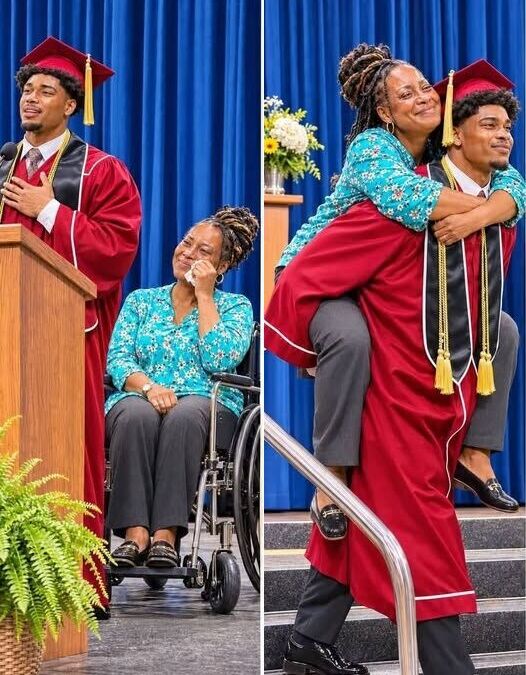
The following June, Tyler came home from his first year for the next graduation ceremony at the school. A friend’s little brother was finishing. He said he wanted to see the stage again. He had no idea what I had been planning.
When it was over and the families were filing out, I asked him to push me up to the front of the empty auditorium. Rick came with us. Tyler did not understand why.
At the bottom of the stage stairs I asked him to stop.
Rick knelt down and buckled the lightweight braces onto my legs, the ones they fitted me for in March. He put the forearm crutches into my hands. He switched on the small stimulator at the base of my back. Then he stepped away.
Mom, Tyler said. What are you doing?
I took a breath and put my weight on the crutches.
And I stood up.
My son made a sound I have never heard him make in his life.
I stood there shaking, hanging onto those crutches. Then I moved my right foot. An inch. Then the left. Another inch. Then the right again.
Six steps. Slow and shaky and terrifying, across to the bottom of the stage stairs, where my son was standing with both hands over his mouth.
A year ago you carried me up these stairs, I said.
He was crying too hard to answer.
I cannot climb them yet, I said. Not yet. But I wanted to walk to you. Just once. The way you walked to me.
He threw his arms around me, crutches and braces and all, and held me up, and I did not fall.
Behind him Rick stood in the aisle with the grey cap in his hands, crying without a sound. I looked at him over our son’s shoulder.
And for the first time in seven years I looked at him the way Tyler had hoped I would. Just once. That was all it took.
Is the Treatment in This Story Real?
⚠️ Don’t miss the rest! The full article continues on the next page 👇📖
Tap “Next Page” to see all the details, tips…