Oh, I’m so glad you asked this! You know, I was just at the grocery store last week, standing in the produce section, looking at all these long, green, onion-like vegetables, and I thought to myself, “My goodness, are they all the same thing, or is there a difference?”
At 73, I’ve certainly used all of these in my kitchen over the decades, but I’ll admit, I’ve called them by the wrong names more times than I’d like to count!
So, I put the kettle on, grabbed my favorite mug of ginger tea, and did some research to finally set the record straight.
Grab your apron, because we’re about to clear up this delicious confusion once and for all!
The Quick Answer: What’s What?
Here’s the simple breakdown:
| Vegetable | Botanical Name | Key Feature | Flavor |
|---|---|---|---|
| Scallions | Allium fistulosum | No bulb, straight white base | Mild, fresh |
| Green Onions | Allium fistulosum | Same as scallions (often used interchangeably) | Mild, fresh |
| Spring Onions | Allium cepa | Small, rounded bulb | Sweeter, stronger |
| Chives | Allium schoenoprasum | Very thin, grass-like, no bulb | Delicate, subtle |
The Detailed Breakdown
1. Scallions and Green Onions: The Same Thing! 🟢
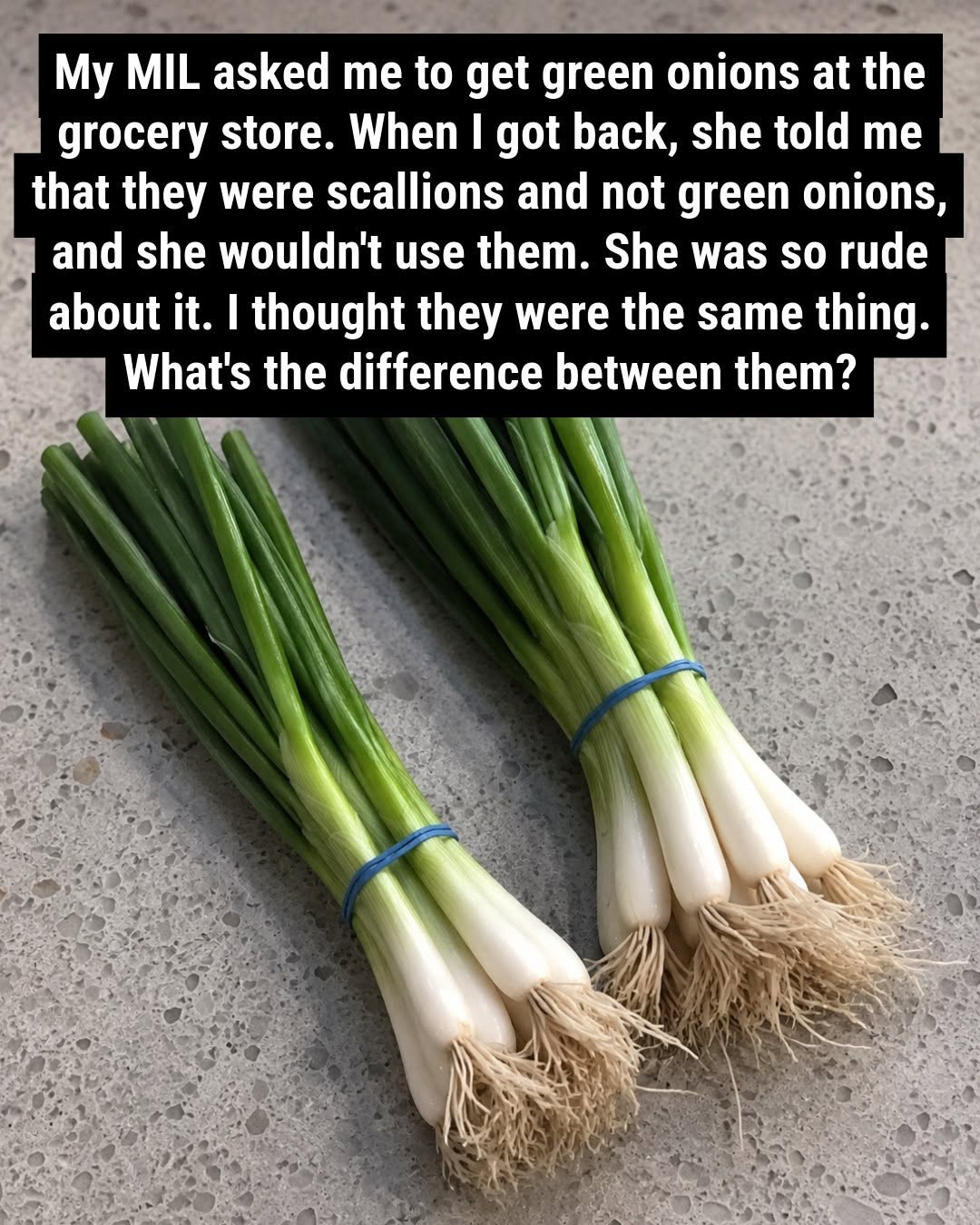
Here’s the biggest surprise: Scallions and green onions are actually the same vegetable! The terms are used interchangeably in most places, though there are some subtle regional differences:
What they are:
- Young onions harvested before the bulb has formed
- They have a straight, white base (no rounded bulb)
- Long, hollow green tops
- Both the white and green parts are edible
Flavor profile:
- Mild, fresh, slightly peppery
- The white part is a bit stronger; the green part is more delicate
- Perfect for raw applications
Best uses:
- Garnishing soups, salads, and baked potatoes
- Stir-fries (add at the end for freshness)
- Salsas and fresh relishes
- My 3-Ingredient Avocado & White Bean Smash (they add the perfect fresh bite!)
Kitchen tip: In the United States, “green onion” is more common on grocery store labels, while “scallion” is often used in recipes and by chefs. But they’re the same thing!
2. Spring Onions: The Slightly Older Cousin 🧅
Spring onions are often confused with green onions, but there is a difference!
What they are:
- A slightly more mature onion than scallions/green onions
- They have a small, rounded bulb at the base (this is the key difference!)
- The bulb can be white, yellow, or even red, depending on the variety
- Still harvested young, but given a bit more time to develop
Flavor profile:
- Sweeter and slightly stronger than scallions
- The bulb has a more pronounced onion flavor
- The greens are still mild and fresh
Best uses:
- Grilling or roasting (the bulb caramelizes beautifully!)
- Hearty soups and stews
- Pickling
- When you want a bit more onion punch than a scallion provides
Kitchen tip: In the UK and Australia, “spring onion” is the common term for what Americans call “green onions” or “scallions,” which adds to the confusion! But true spring onions have that distinct bulb.
3. Chives: The Delicate Herb 🌿
Chives are in a category of their own—they’re an herb, not a young onion!
What they are:
- A member of the onion family, but a completely different species
- Very thin, hollow, grass-like green stems (no white bulb at all!)
- Sold in fresh bunches or as dried herbs
- Also available as garlic chives (flat leaves with a garlic flavor)
Flavor profile:
- Delicate, subtle onion flavor
- Much milder than scallions or spring onions
- Best used fresh; cooking diminishes their flavor quickly
Best uses:
- Garnishing (they’re beautiful snipped over dishes!)
- Baked potatoes
- Omelets and scrambled eggs
- Cream cheese and herb spreads
- My Low-Carb Ham and Cheese Egg Bakes (they add the perfect fresh finish!)
- Sprinkled on soups right before serving
Kitchen tip: Chives are so delicate that you should always add them at the very end of cooking, or better yet, use them raw as a garnish. Heat destroys their flavor!
The Visual Guide: How to Tell Them Apart at the Store
Scallions / Green Onions:
- ✅ Straight white base (no bulb)
- ✅ Long, hollow green tops
- ✅ Uniform thickness from root to tip
Spring Onions:
- ✅ Small, rounded bulb at the base
- ✅ Green tops similar to scallions
- ✅ Bulb may be white, yellow, or red
Chives:
- ✅ Very thin, grass-like stems
- ✅ No white bulb at all
- ✅ Sold in small, delicate bunches
Substitution Guide: What If I Can’t Find the Right One?
Don’t worry! These are all members of the allium family, so they can often be substituted for one another. Here’s how:
| Recipe Calls For: | You Can Substitute: | Ratio & Notes: |
|---|---|---|
| Scallions / Green Onions | Spring onions | Use 1:1, but expect a slightly stronger flavor |
| Scallions / Green Onions | Chives | Use 1:1, but add at the end (chives are more delicate) |
| Spring Onions | Scallions + a bit of yellow onion | Use scallions for the greens, add a tiny bit of regular onion for the bulb flavor |
| Chives | Green onion greens only | Use the green part only, finely sliced (about 1:1) |
Important: Never substitute chives for spring onions in a cooked dish where the onion needs to hold up to heat—chives will just disappear!
The “Avocado Lover’s” Kitchen Tips!
Since I have a strong personal preference for avocados and incorporate them into almost every single meal (even though my children absolutely do not share my liking for them, which just means I get to enjoy the whole batch!), I love using all of these alliums to brighten up my avocado dishes:
- Scallions/Green Onions: Perfect in my 3-Ingredient Avocado & White Bean Smash for a fresh, mild bite
- Spring Onions: I grill them and serve them alongside my avocado toast for a sweet, caramelized contrast
- Chives: I snip them finely over my mashed avocado for a delicate, elegant finish
All of these are wonderful for circulation health! They contain antioxidants and compounds that support healthy blood vessels, which is always on my mind as I keep an eye on those unexplained purple blotches on my arms.
Storage Tips: Keep Them Fresh Longer!
Scallions / Green Onions / Spring Onions:
- Wrap in a damp paper towel and store in a plastic bag in the fridge
- Or, stand them upright in a glass with an inch of water (like flowers!) and cover loosely with a plastic bag
- Lasts 1-2 weeks
Chives:
- Wrap in a slightly damp paper towel and store in a plastic bag in the crisper drawer
- Or, chop and freeze in ice cube trays with a bit of water or olive oil
- Fresh chives last about 1 week; frozen last up to 6 months
Frequently Asked Questions
Q: Are green onions just young regular onions? A: Not exactly! Green onions/scallions are a specific variety (Allium fistulosum) that never forms a large bulb. Regular yellow, white, or red onions are a different species (Allium cepa) and will form bulbs if left to mature.
Q: Can I eat the green tops of regular onions? A: If you see green shoots growing from a regular onion in your pantry, those are edible, but they can be quite bitter and tough. They’re best used in cooked dishes where they can soften.
Q: Why are chives so expensive? A: Chives are delicate, perishable, and labor-intensive to harvest. They also have a shorter growing season and don’t store as well as other alliums, which drives up the price.
Q: Can I grow these at home? A: Absolutely! Chives are especially easy to grow in a pot on a sunny windowsill. Green onions can also be regrown from the white root ends—just place them in water and watch them sprout!
The Bottom Line
Here’s the simple takeaway:
- Scallions = Green Onions (same thing, interchangeable terms)
- Spring Onions have a small bulb and a slightly stronger flavor
- Chives are a delicate herb with thin, grass-like stems
All of them are delicious, nutritious, and add a fresh, oniony brightness to your cooking. The key is knowing which one to use based on the flavor intensity and texture you’re looking for!
I truly hope this deep-dive into the world of green onions, scallions, spring onions, and chives brings some clarity to your next grocery trip. It’s so empowering to know the differences, so we can make informed choices and create the most delicious, flavorful dishes possible.
If you’ve ever been confused by these alliums at the store, you’re definitely not alone! Now you can shop with confidence and choose the perfect one for your recipe.
Do you have a favorite way to use any of these? I’d absolutely love to hear how you incorporate them into your cooking! Drop a comment below to share your wisdom, and please share this article with a friend who loves to cook.